School is my safe space – or not.
Today morning, a young boy, about 5 or 6 years old at most, got slapped. Really hard. By his mother. I’ll call him Amani*.
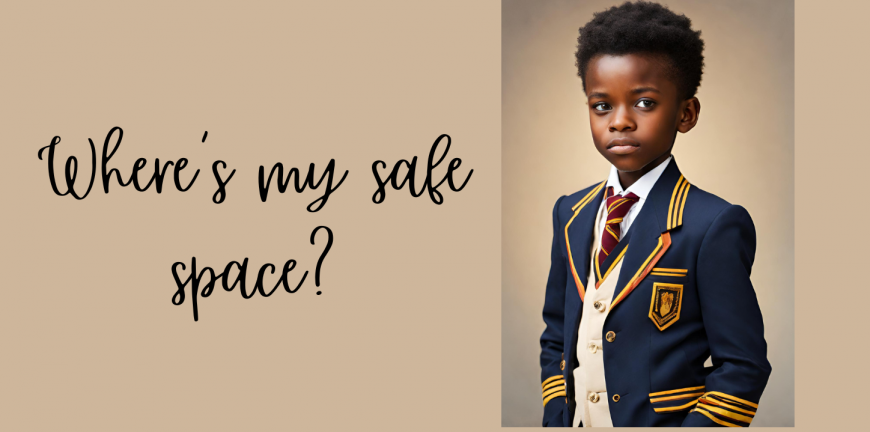
Amani was looking sharp in his school uniform, which was topped up with a slightly oversized blazer (the kind kindergarteners wear nowadays for Monday morning assembly in school.) He was accompanied by his siblings, one younger and another older, and his mother and nanny. As they were crossing the road to school, he did something that elicited a loud reprimand and a louder slap across his face. The mother, who had let go of the older sibling to slap Amani, grabbed back the older child’s hand and they continued to cross the road. Amani’s hand was being held by the nanny. They, too, continued to cross the road.
This event was at a pedestrian crossing, and in full view of a variety of drivers and passengers getting to their places of work or to wherever else they were going to on this fine Monday morning. The boda boda (motorbike) riders and their passengers, fellow pedestrians, passers-by on the roadside and traffic policemen were also witness to the scene.
This got me thinking – what kind of day is the young boy going to have? Will he act out and hit another child at the slightest provocation? Will he shy off and withdraw into himself thinking “I am not loveable”? Will he be met by a loving, caring teacher, who will show him so much love and acceptance that school becomes his place of refuge? Or will his teacher be a disgruntled one, who is just hoping the days pass fast as she awaits a much-needed, meagre, January salary, thus making school an extension of this boy’s tough life?
Or…as we are wont to say in our motherland, was he just a boy who needed to be “disciplined” to prevent him “growing horns”? Actually, are boys born aggressive or do we force the testosterone out? After all, how will they develop their self-defence?
What did Amani’s siblings think or feel? Or are they accustomed to this? Did they continue walking thinking to themselves, “He is always… and needs to be hit”? Or did they quietly toe the line to timidly avoid getting similar treatment? How about the nanny? Will she get a chance to love on the boy and be someone he can go to for solace at home? Or is she an enabler to the abuse, saying, like everyone else, “Amani is just difficult”?
Where is his dad? Is his relationship with Amani any better? Or is he a contributing factor to the mother’s anger that is then meted out on the children? Is he out there struggling to feed his family in these tough economic times, such that parenting has been delegated or pushed to the far future when the family is “more stable”?
Will Amani experience the meaning of his name today? This week? In life?
Dear parents, no child deserves to be slapped in public – or anywhere else for that matter. For starters, it can damage the ear. Even worse are the psychological effects of the beatings. These last long-term and may even affect the adult this child becomes. Heal so that you do not bleed on your children. Seek support in whatever form is accessible to you – friends, religious leaders, therapists and so on. Make it easy for your child to do life – it’s already going to be such a tough world out there. Be their safe space, where they can come lick their wounds from others.
Dear kindergarten and preschool teachers, you have no idea what the children who walk into your classroom every morning are facing back home, and on their way to school. Greet them with a high five, fist bump, hugs, little jig, or any expression of “I’m so glad to see you!” As Rita Pierson said, “Every child needs a champion.” Be that champion for them. Not parent. Champion. Be that one person who can assure them that everything can turn out alright. A teacher affects eternity; he can never tell where his influence stops. – Henry Adams.
Dear parent and teacher, we understand your struggles and pain. This is a tough time to be raising children or teaching children. You need all the help you can get. If all else fails and you are looking for support, tips and tools for this journey, reach out. We are ready to help in various ways. We are here to connect generations and make the world a safer and happier place for families. You need not face it alone. Let’s do what we can to ensure Amani (and others like him) can grow up in peace and surrounded by love.
*Amani means Peace in Swahili.